
PowerPoint makes it easy to create handouts, but the default style is one of the worst things you can give your audience. Here’s a better idea.
Default PowerPoint handout
Here’s what the default PowerPoint handout looks like:
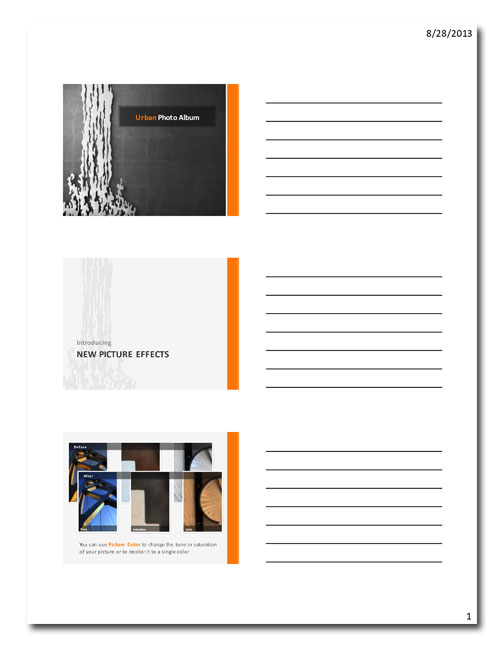
It seems helpful enough. This kind of handout shows an image of your slide with a space to write notes. But wait up! Before you go and print a hundred of these for your next big speech, consider this:
[highlight]This kind of handout is a huge waste of paper.[/highlight]
- Animated slides result in slide images that look like a many-layered mess.
- Decks that use full-screen pictures look great to the audience but are useless on handouts, since many of them may appear on-screen for only a few seconds.
- Presentations that have lots of animation and pictures contain lots of slides. Are all of them noteworthy? Probably not.
- Finally, let’s be honest. How many of this type of handout have you ever actually filled out and kept on file for future reference? Yeah, that’s what I thought.
A better kind of handout
“But, Laura!” you say. “I’ve got to give my audience something!” OK, then, let’s take a look at another style of handout, one that includes the speaker notes.
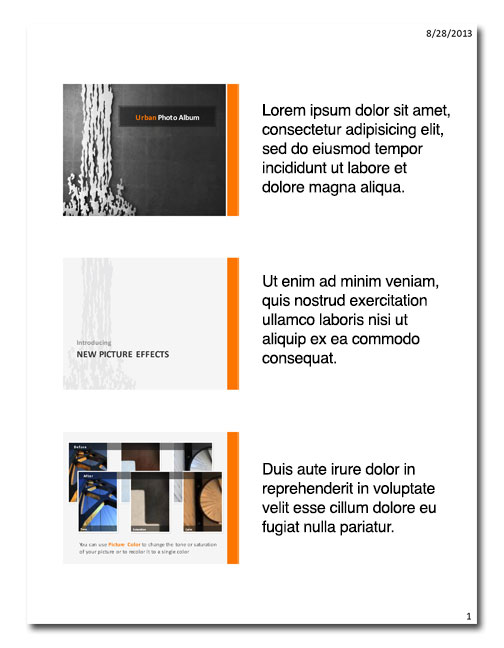
Hmmm, this seems better. Let’s compare the benefits to the drawbacks of this kind of handout.
[raw]
[one_half] Benefits of Handouts [/one_half]
[one_half last] Drawback of Handouts [/one_half]
[clear]
[/raw]
[raw]
[one_half] Handouts eliminate the need to take notes. [/one_half]
[one_half last] You should encourage note-taking so that people can jot down things they find relevant. If they have a handout, it’s already done for them.[/one_half]
[clear]
[/raw]
[raw]
[one_half] Handouts provide a reference during your presentation. [/one_half]
[one_half last] …which your audience will be ignoring if you distribute them when they arrive. They’ll be too busy flipping through their handouts to pay attention to you. [/one_half]
[clear]
[/raw]
[raw]
[one_half] Handouts can be referred to long after your speech is over. [/one_half]
[one_half last] Again, how many handouts do you have on file that you actually go back to? I’m willing to bet it’s not a large number. [/one_half]
[clear]
[/raw]
The best kind of handout
“All right, now you’re just being negative!” I can hear you saying now. “What are we supposed to give our attendees, anyway?” You should give them the best kind of handout: a brief summary of your main talking points that provides ways to continue the conversation.
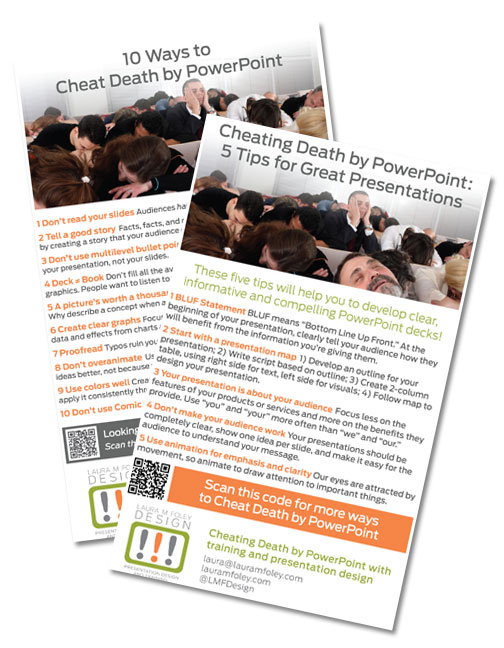 Here’s a picture of some handouts that I distribute at my presentations. What makes them the best kind of handout?
- They have titles: The titles clearly state the contents of the handout.
- They are branded: From the image to the typeface to the colors to the logo, these handouts have all of the brand elements of Laura M. Foley Design.
- They look alike: Handouts are marketing collateral. As such, they should look like they all come from the same company.
- They cover the highlights: Providing the entire script of your presentation can be overkill. By showcasing your main talking points, you provide a good summary of what you want people to remember.
- They are interactive: There’s a QR code that people can scan which brings them to my website.
- They provide contact information: I give people three ways to get in touch with me: my email address, website URL, and Twitter handle.
It’s not hard to create this type of handout; you can do it in PowerPoint. Save them as PDF files and have them professionally printed for handouts that do what they’re supposed to: be helpful and allow future interaction.
Your Turn
What types of handouts have you found to be the most effective?
Very nice piece of work (as always) Laura. A quick question. How do you overcome the all to common yet insane request “will we get a copy of your slides?”. This is a silly question because as we all know, slides that perform communication in the absence of the presenter cannot ‘presentation’ slides and vice-versa, handouts cannot serve as a presentation tool. It seems that along with the loved “Death by PowerPoint” phase, the human race has been programmed to behave as if in a permanent state of fear whereby they may miss something if they don’t have everything handed to them on a plate!
I agree, that is an inane question. I suppose the real request-behind-the-request is that they want to be able to show your presentation to people who aren’t able to attend the scheduled event. Plus, they might not have a full grasp of the concept of “intellectual property.” You really can’t blame them, since many presenters have no qualms at all about giving their slides away. But savvy presenters like you and I know that our presentations are valuable, so giving them away to be used in who knows what way isn’t a good business decision.
You might explain that the slides wouldn’t help them without you there to guide them through the presentation because there aren’t any Speaker Notes, the pictures don’t make sense without your narration, etc. This could be an opportunity for follow-on sales: your book on the subject, additional training, an exclusive webinar, etc. If all that fails, you could offer to license your presentation to them.
Giving away presentations simply isn’t an option for professional speakers.
Excellent post!
I have found that a horrifying number of bad, text heavy, overstuffed presentations are created under the assumption that the presentation will be the handout. Conference organizers don’t help when they ask speakers for a “copy of the slides” for the audience.
It’s pretty simple: a good presentation is a bad handout and vice versa.
Absolutely right, Konrad!
Another answer to this request is to post PDFs of your handouts, eBooks, etc., on your website, then send the URLs to the conference organizers. You could be extra-nerdy and send them a QR code to include in the program that links to this page.
Great article! It explains the PowerPoint handout issues and shows some great alternatives – and by “issues” I mean the limitations of PowerPoint when it comes to creating usable handouts. One thing that I think should be more clear is that each of the better handout ideas (and they are better!), are not options PowerPoint offers, but separate documents.
Handouts are a big part of many projects I get and almost every project with a handout request is the same conversation – here is what PowerPoint can offer for handouts (I know you do not like that), here is a custom layout we can do with PowerPoint to improve on the offered handouts (Yes, that is nicer and I agree it is not exactly what you want), here are examples of custom notes page layouts created as separate documents that are developed after the presentation is finalized (Yes, these are much nicer, more professional and better for your attendees. Yes, they do adjust the project budget) – and the client almost always chooses the separate document layout, which are similar to your great examples.
Troy Chollar
http://www.ThePowerPointBlog.com
Thanks for your comments, Troy.
The handouts that I distribute during my presentations and the last example shown were created in InDesign. It’s possible to do the same kind of layout in PowerPoint, with bleeds and everything. Since PowerPoint slides can be exported as PDFs it’s not difficult to have these printed and trimmed to size. True, there can be color shifts when making the RGB to CMYK transition, but for me that’s not an issue.
The “better” example that includes the Speaker Notes was generated in PowerPoint. You just go to File/Save & Send/Create Handouts and PowerPoint automatically creates a Word handout. This can be edited in Word before being printed and distributed.
Laura, this is the best answer to that question I have ever seen! It might be a little extra work to create the handout you mention above, but it would be infinitely more helpful.