Before: Just the facts, ma’am
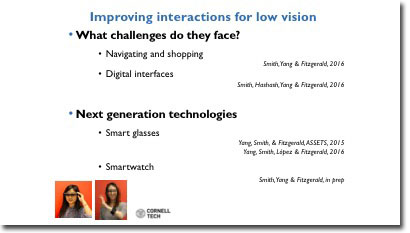
This slide presents the problems that people with low vision face and the solutions that the speaker is proposing. But there’s more to vision loss than what appears on the slide. In addition to not being able to see as well, there are problems like the loss of independence, confidence and ability to care for oneself. The emotional tolls faced by people with vision loss are not addressed on this slide.
Conversely, the solutions offered aren’t highlighted particularly well. The slide presents some amazing technology, but the images are tiny and the descriptions brief.
After: Photos and storytelling
Slide 1

I created three slides from the original. In this slide, we see a man in sharp focus against a backdrop of blurry products on shelves. The text on the slide briefly describes what we’re looking at, but there’s more to it. To successfully present this slide, the speaker would tell us a story, real or fictitious, about the problems this man faces every day now that he’s losing his vision. Maybe he can’t drive anymore, maybe he’s too proud to admit that he can no longer read labels.
Stories are memorable and relatable. Now instead of bullet points, we might be thinking of a father, uncle, brother, etc., who’s going through the same thing.
Slide 2
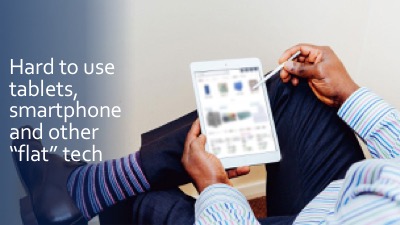
My cousin used to be an assistant to a blind man. This man had a computer that he’d modified for his own use, with a clacky keyboard that provided tactile feedback and software that read aloud what was onscreen. The advent of smartphones and tablets was not good news for him, because these devices favor the sighted. He dismissed them as “flat sh*t.”
Think about how often you interact with your tech. Could you do it with your eyes closed?
As before, with this redesign we present the reality of not being able to see a screen and we can build a story around it. With these two slides, we put a human face on the data. We give the audience a reason to care about and hope for a solution.
For both of these slides, I would advise the speaker to present them in a subdued, serious tone of voice to reflect the severity of the problem.
Slide 3
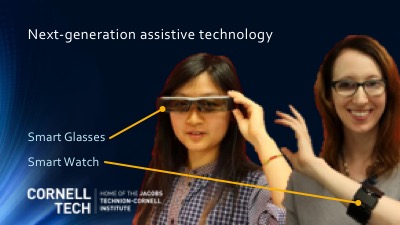
I’ve enlarged the photos of the women who are showing off the assistive devices so they’re more dramatic and I found a white version of the current Cornell Tech logo that works well against the redesigned background.
I’d advise the speaker to bring these devices to the presentation, if possible, and demonstrate their use. This is very exciting technology, so I’d also tell the speaker to perk up and present this slide in an excited, optimistic way.
Don’t be afraid to get emotional
Making an emotional connection with the audience is a powerful way to get them to listen and really pay attention to what you’re saying. Stories are a great way not only to address the emotions behind what we’re talking about, but also to create memorable, relatable content that audiences will be thinking about long after the presentation is over.
You must be logged in to post a comment.